
98% of ferrous fines.
No media, continuous operation.
The MD Magnetic Separator uses rotating magnetic discs to continuously remove ferrous fines up to one-quarter inch from water-based coolants, synthetic coolants, alkaline wash water, and oil-based fluids. It provides 98% ferrous removal without disposable filter media.


- 98%
- ferrous removal efficiency
- ≤1/4 in
- ferrous fines captured
- 0 media
- no bags, no consumables
- 13–396 gpm
- 11 models, water-based
Continuous magnetic separation with automatic solids discharge
The MD Magnetic Separator removes ferrous fines from water-based coolants, synthetics, and alkaline wash water to extend fluid life. It is compact, runs continuously, and uses no filter media.
- No disposable filter mediaPermanent rotating magnets capture the solids and a scraper discharges them continuously, eliminating filter-bag changes.
- Cleaner fluid, longer lifePulling fines out continuously means fewer reservoir pump-outs, less machine wear, and longer coolant life.
- Savings and payback for your applicationSimple payback can be estimated from the quoted investment and current maintenance, coolant, downtime, and disposal costs.
What the magnet captures, and what passes
| Contaminant | On the discs |
|---|---|
| Ferrous finesSteel and cast iron swarf, sludge | Captured |
| Non-ferrous finesAluminum, brass → paper bed filter | Passes |
| Tramp oilOil & recycling → C.R.O.S.S. | Passes |
For mixed particulate loads, place magnetic separation ahead of media filtration. EdjeTech can review the fluid, material mix, and solids sample to confirm the required stages.
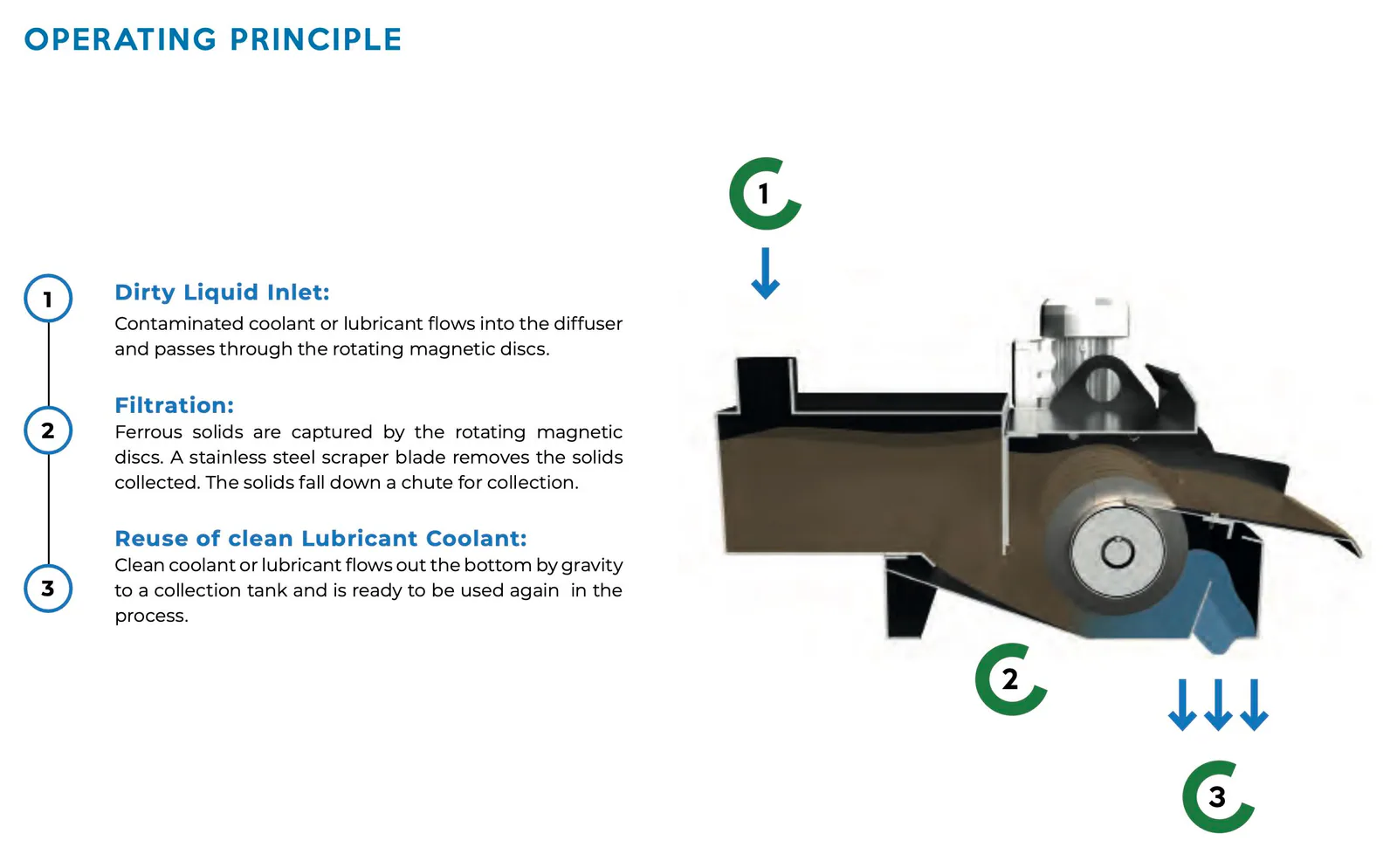
How the MD cleans your coolant
Dirty coolant enters at the top, ferrous solids exit at the side, and clean coolant flows out the bottom by gravity. No filter media sits in the path.
The separator is rated to a maximum fluid viscosity of 20 cSt at 100°F. Because capture uses a permanent magnet and scraper blade, the unit operates while the machine it serves keeps running, with no stop to change media.
Operating features and production value
Continuous magnetic separation reduces filter-media use, reservoir maintenance, equipment wear, and filtration-related downtime.
| System function | How it works | Operating result |
|---|---|---|
| Rotating magnetic discs | The coolant stream passes over permanent magnets that capture ferrous fines. | 98% ferrous removal during continuous operation. |
| Automatic scraper blade | A stainless steel blade strips the captured solids off the discs and drops them down a chute. | Autonomous operation. Operates without continuous operator oversight or filtration-related shutdown. |
| No filter media | Permanent magnets and a scraper blade remove solids without bags or disposable fabric. | No filter-media expense and no spent media to dispose of. |
| Continuous operation | The unit removes fines during machine operation without filtration-related cleaning downtime. | Lower maintenance hours and no production stoppage for filtration. |
| Efficient solids collection | Scraped fines fall straight into a 55-gallon drum or a portable chip dumpster. | Fines leave the fluid before they settle in the sump, so reservoir pump-outs drop. |
| Gravity-flow outlet | Clean fluid leaves the bottom by gravity to a tank or the next filtration stage. | Gravity-flow integration with an existing process line, without an additional discharge pump. |
| Cleaner fluid, held longer | Pulling the ferrous load out continuously keeps the coolant in working condition. | Less machine wear and longer fluid life. Economic return depends on the quoted investment and current operating costs. |
Magnetic separation ahead of downstream filtration
For grinding, cast-iron machining, and other ferrous-heavy applications, magnetic separation removes the primary solids load before the coolant reaches fabric filtration or a recycling system. These applications often combine magnetic separation with downstream fabric filtration and coolant recycling, and the complete configuration can be included in one quotation.
- Stage 01Primary stage
Magnetic separator
Ferrous finesRemoves the heavy ferrous load at 98% efficiency before the fluid reaches downstream media filtration, with no filter-media consumables.
↓ Ferrous to drum - Stage 02Downstream
Paper bed filter
Non-ferrous & fine solidsCaptures non-ferrous and remaining fine solids after the magnetic load has been removed, extending fabric life. Both stages are available together as the DCO Filter System.
Review paper bed filtration →↓ Non-ferrous fines to media - Stage 03Downstream
C.R.O.S.S.
Tramp oil & recyclingRemoves tramp oil, maintains coolant concentration, and returns recycled coolant to service at the facility level. When magnetic prefiltration is integrated with a C.R.O.S.S. recycling system, the complete system can reduce new-fluid purchases by up to 85%.
See C.R.O.S.S. →↓ Tramp oil separated
Eleven models, sized by flow
The model number reads as rated water flow in liters per minute. Full dimensional drawings ship with the spec sheet.
| Magdisk | Water GPM | Oil GPM | Length A (in) | Height C (in) | Inlet G |
|---|---|---|---|---|---|
| 50 | 13 | 9 | 7.4 | 14.5 | 1" |
| 100 | 26 | 18 | 9.6 | 16.7 | 1-1/2" |
| 150 | 39 | 27 | 12.9 | 20.0 | 2" |
| 200 | 52 | 36 | 15.1 | 22.2 | 2" |
| 300 | 79 | 55 | 21.8 | 29.8 | 2-1/2" |
| 400 | 105 | 73 | 29.5 | 37.5 | 3" |
| 500 | 132 | 92 | 37.2 | 45.3 | 3" |
| 600P | 158 | 110 | 20.5 | 31.0 | Confirm with quoted drawing |
| 800P | 211 | 148 | 31.9 | 43.3 | Confirm with quoted drawing |
| 1000P | 264 | 184 | 37.6 | 49.0 | 6" / DN100 |
| 1500P | 396 | 277 | 58.3 | 69.8 | 6" / DN100 |
- Water-based coolantPrimary rating, full GPM
- Synthetic & semi-syntheticWater-miscible fluids
- Alkaline wash waterParts-washer reservoirs
- Neat & cutting oilsReduced flow, see oil GPM
Each model is rated for both water-based fluids and oil (the two GPM columns above), up to a maximum viscosity of 20 cSt at 100°F. Tramp oil and non-ferrous solids pass through the magnetic separator. A paper bed filter captures non-ferrous solids; C.R.O.S.S. adds tramp-oil separation and coolant recycling.
- 98%
- Ferrous removal efficiency
- 1/4 IN
- Max ferrous particle size captured
- 20 cSt
- Max fluid viscosity at 100°F
- Gravity
- Clean-fluid outlet; no discharge pump required
P-frame models (600P–1500P) provide the high-flow configuration. Each model has separate ratings for water-based coolant and neat oil. Applications above 396 GPM or at tube-mill flow require engineering review and may include multiple filtration stages. Request dimensional drawings →
Built for ferrous grinding and machining
Cast iron and steel are the core duty: the swarf, sludge, and ferrous fines those processes generate.
- 01GrindingCenterless, surface, and cylindrical; cast iron and steel fines
- 02Turning & general machiningFerrous swarf from machining centers and lathes
- 03Tube & pipe millsFerrous fines at mill flow, paired with a paper bed
- 04Parts washingAlkaline wash water carrying ferrous particulate
- 05Cast iron workHeavy ferrous sludge loads ahead of recycling
- 06Pre-stage to recyclingFirst stage ahead of a paper bed or a C.R.O.S.S. system
Product and application questions
- 01
Will it remove my fines?
Ferrous particles up to one-quarter inch are removed at 98% efficiency. Aluminum and brass are non-ferrous and require paper-bed or combination filtration. For mixed particulate loads, install magnetic separation before media filtration.
Talk to an engineer → - 02
What does it cost to run?
No filter media, bags, or related consumables are required. The rotating discs and scraper operate continuously without shutdown for media changes or routine scraper cleaning, while captured fines discharge into a drum or chip dumpster.
- 03
Is it sized for my flow?
Eleven standard models cover 13 to 396 GPM on water-based fluids and 9 to 277 GPM on oils, with model-specific ratings shown above. Higher-flow and tube-mill applications require an engineering review of the complete filtration system.
Request a sizing review → - 04
How does it differ from a sump or drum magnet?
A sump or drum magnet captures the ferrous material that reaches its surface. The MD Magnetic Separator processes the coolant stream over rotating magnetic discs and automatically scrapes the captured solids, providing 98% ferrous removal.
Keep ferrous fines from recirculating
Remove steel and iron fines before they recirculate and contribute to wear or poor surface finish.
- Equipment quotation
Request a quote
Reduce recirculating ferrous fines that contribute to wear and poor finish.
Request a quote → - Estimate savings and payback
Savings calculator
Estimate application-specific simple payback using current operating costs and quoted investment.
Estimate savings → - High flow or custom duty
Talk to an engineer
Discuss high-flow treatment or particles a magnet cannot collect.
Talk to an engineer → - Request
Spec sheet
The dimensional drawings and full model table for the specifying engineer.
Get the spec sheet →